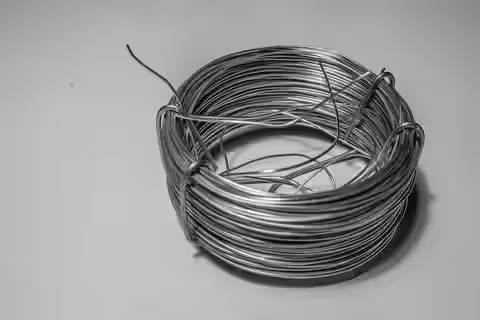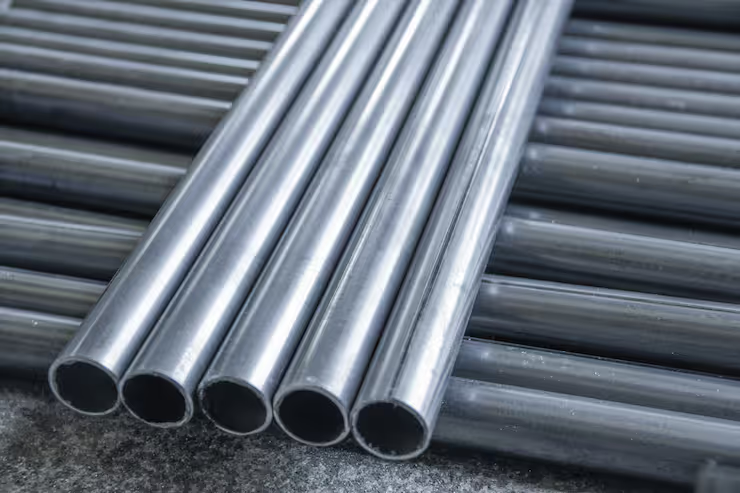
Custom stainless tubing manufacturing refers to the production of metal tubes designed to meet specific industrial requirements. These tubes are made using stainless steel due to its durability, corrosion resistance, and adaptability across various environments.
Stainless steel is widely used because of its corrosion resistance, durability, and strength. Industries such as aerospace, automotive, pharmaceuticals, and construction rely on customized tubing solutions to meet strict engineering and safety standards.
The need for customization arises because standard tubing cannot always meet the unique demands of advanced systems. For example, medical devices require extremely precise tubing dimensions, while oil and gas pipelines demand high-pressure resistance and durability in harsh environments.
Custom manufacturing ensures that tubing fits exact specifications, supports operational efficiency, and reduces the risk of failure in critical systems.
Why Custom Stainless Tubing Matters in Modern Industries
Custom stainless tubing plays an essential role in supporting modern infrastructure and advanced technologies. It impacts a wide range of sectors and helps solve several engineering challenges.
Key reasons this topic is important today
- Precision engineering requirements: Modern machinery requires exact measurements and tolerances
- Corrosion resistance: Stainless steel performs well in extreme environments
- Sustainability goals: Long-lasting materials reduce waste and replacement frequency
- High-performance systems: Industries like aerospace and healthcare depend on reliability
Industries that rely on custom stainless tubing
- Automotive manufacturing and electric vehicles
- Oil and gas pipelines
- Food processing and beverage systems
- Pharmaceutical and biotechnology equipment
- Construction and infrastructure projects
Problems it helps solve
- Material degradation in harsh environments
- Leakage or failure in high-pressure systems
- Incompatibility with specialized equipment
- Inefficiency due to non-standard components
Custom stainless tubing manufacturers contribute to safer, more efficient, and longer-lasting industrial systems by addressing these issues.
Recent Trends and Updates in Custom Stainless Tubing
Over the past year, several developments have influenced how custom stainless tubing is designed and produced.
Notable updates and trends
- 2026: Increased adoption of automation in manufacturing processes to improve precision and reduce defects
- 2026: Growing demand for lightweight yet strong tubing in electric vehicles and renewable energy systems
- 2025–2026: Integration of digital modeling and simulation tools for better design accuracy
- 2026: Expansion of sustainable manufacturing practices, including recycling stainless steel materials
- 2026: Rising use of advanced alloys for enhanced corrosion and heat resistance
Emerging technologies
- Laser welding and cutting techniques
- Computer Numerical Control (CNC) machining
- Additive manufacturing (3D printing) for prototypes
- AI-based quality control systems
These advancements are helping manufacturers produce tubing with higher accuracy, improved performance, and reduced environmental impact.
Regulations and Policies Affecting Stainless Tubing
Custom stainless tubing manufacturing is influenced by various standards and regulations that ensure safety, quality, and environmental compliance.
Key regulatory areas
- Material standards: Specifications for chemical composition and mechanical properties
- Quality certifications: Requirements for testing and inspection
- Environmental regulations: Guidelines for emissions and waste management
- Industry-specific compliance: Rules for sectors like healthcare and food processing
Common standards followed globally
- ASTM (American Society for Testing and Materials)
- ISO (International Organization for Standardization)
- ASME (American Society of Mechanical Engineers)
Example regulatory considerations in India
- Bureau of Indian Standards (BIS) guidelines
- Environmental protection norms for industrial manufacturing
- Safety standards for industrial equipment
These regulations ensure that tubing products are safe, reliable, and suitable for their intended applications.
Tools and Resources for Custom Stainless Tubing
Various tools and resources support the design, analysis, and manufacturing of custom stainless tubing.
Design and engineering tools
- CAD (Computer-Aided Design) software for creating precise models
- Simulation tools for stress and thermal analysis
- Material selection databases
Manufacturing technologies
- CNC machines for accurate shaping and cutting
- Laser cutting systems for precision fabrication
- Automated welding equipment
Helpful resources
- Industry standards documentation (ASTM, ISO)
- Engineering calculators for pressure and stress analysis
- Technical guides on stainless steel properties
- Online platforms for material specifications
Common tools overview
| Tool Type | Purpose | Benefit |
|---|---|---|
| CAD Software | Design and modeling | High precision designs |
| Simulation Tools | Performance testing | Reduced risk of failure |
| CNC Machines | Manufacturing | Consistent quality |
| Laser Cutting Systems | Precision cutting | Clean and accurate finishes |
| Material Databases | Material selection | Better decision-making |
These tools help engineers and manufacturers create reliable and efficient tubing solutions.
Frequently Asked Questions
What is custom stainless tubing used for?
Custom stainless tubing is used in industries such as automotive, aerospace, healthcare, and construction. It is designed to meet specific requirements like size, strength, and resistance to environmental factors.
How is stainless tubing customized?
Customization involves adjusting dimensions, wall thickness, material composition, and surface finish. Advanced manufacturing techniques ensure precise results.
Why is stainless steel preferred for tubing?
Stainless steel offers excellent corrosion resistance, durability, and strength. It performs well in extreme temperatures and harsh environments.
What factors affect tubing performance?
Key factors include material quality, manufacturing precision, environmental conditions, and compliance with industry standards.
Are there environmental considerations in manufacturing?
Yes, manufacturers focus on reducing emissions, recycling materials, and adopting energy-efficient processes to meet environmental regulations.
Conclusion
Custom stainless tubing manufacturers play a crucial role in modern industrial systems by providing tailored solutions that meet precise engineering requirements. Their work supports a wide range of industries, from healthcare to energy, ensuring reliability and performance in critical applications.
Advancements in technology, including automation and digital design tools, are improving manufacturing processes and product quality. At the same time, regulations and standards ensure safety, consistency, and environmental responsibility.
As industries continue to evolve, the demand for customized, high-performance materials will grow. Understanding the importance, trends, and tools associated with custom stainless tubing helps individuals and organizations make informed decisions and adapt to changing industrial needs.