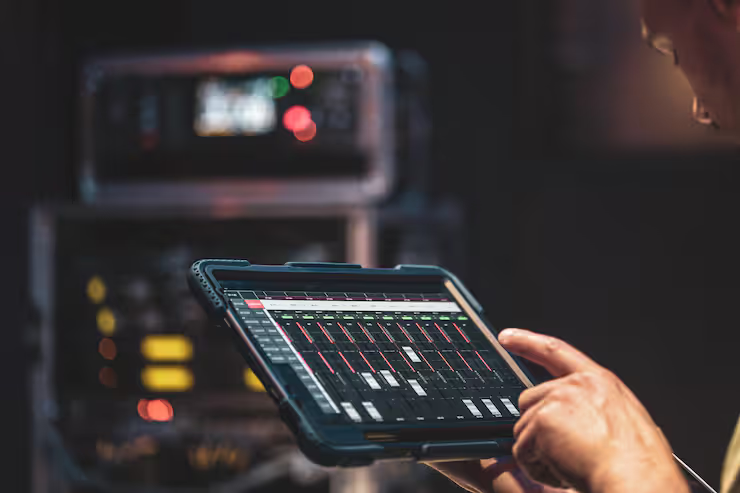
Industrial data loggers are electronic devices designed to automatically record environmental and operational data over time. These devices collect information such as temperature, humidity, pressure, voltage, and other industrial parameters. The collected data is stored digitally and can be analyzed later for performance monitoring, compliance, and optimization.
Industries rely on accurate data collection to maintain safety, efficiency, and quality standards. Manual data recording methods are often prone to human error and inconsistency. Industrial data loggers were developed to solve this issue by providing continuous, automated, and reliable data tracking.
They are commonly used in sectors such as manufacturing, pharmaceuticals, logistics, energy, and agriculture. With the rise of industrial automation and IoT-enabled machinery, data loggers have become a fundamental part of modern industrial systems.
Why Industrial Data Loggers Matter Today
Industrial data loggers play a critical role in today’s data-driven environment. Industries are increasingly focused on improving efficiency, reducing downtime, and ensuring compliance with strict regulations.
They benefit multiple stakeholders, including engineers, plant managers, compliance officers, and quality control teams.
Improved Operational Efficiency
- Continuous monitoring helps identify inefficiencies
- Enables predictive maintenance strategies
- Reduces unexpected equipment failures
Enhanced Data Accuracy
- Eliminates manual recording errors
- Ensures consistent and reliable measurements
Regulatory Compliance
- Maintains records required for audits
- Supports quality assurance processes
Remote Monitoring Capabilities
- Allows monitoring from centralized dashboards
- Useful for distributed industrial operations
Problem-Solving Capabilities
Industrial data loggers address several key challenges:
- Lack of real-time visibility in operations
- Inconsistent data recording methods
- Difficulty in maintaining compliance records
- Delayed detection of equipment issues
Recent Trends and Updates in Industrial Data Loggers (2025–2026)
The industrial data logging landscape has evolved significantly over the past year, driven by advancements in digital transformation and smart manufacturing.
Integration with IoT Platforms
In 2025, many industries began integrating data loggers with IoT platforms. This allows real-time data transmission to cloud-based systems, enabling remote analytics and monitoring.
Adoption of AI-Based Analytics
By early 2026, AI-driven analytics tools have started working alongside data loggers. These tools analyze collected data to predict failures, optimize performance, and improve decision-making.
Wireless and Cloud-Based Logging
Wireless data loggers have gained popularity due to their flexibility and ease of deployment. Cloud connectivity enables secure storage and access to data from anywhere.
Edge Computing in Data Logging
Edge computing allows data processing directly at the device level. This reduces latency and improves response time for critical industrial processes.
Increased Focus on Data Security
With more devices connected to networks, cybersecurity has become a major concern. Recent updates include encryption protocols and secure data transmission methods.
Laws, Regulations, and Policies Affecting Data Loggers
Industrial data loggers are subject to various regulations depending on the country and industry. These rules ensure data accuracy, safety, and compliance.
Data Integrity Standards
Industries such as pharmaceuticals must comply with strict data integrity standards. These ensure that recorded data is accurate, consistent, and tamper-proof.
Environmental Monitoring Regulations
Industries dealing with sensitive materials must monitor environmental conditions. Data loggers help maintain compliance with environmental safety guidelines.
Industry-Specific Compliance
- Food industry: Requires temperature monitoring for storage
- Healthcare: Needs accurate environmental tracking
- Manufacturing: Must maintain operational data records
Government Initiatives
In countries like India, digital transformation initiatives encourage industries to adopt smart monitoring systems. Programs promoting Industry 4.0 technologies have increased the adoption of data loggers.
Data Protection Policies
With cloud-based logging systems, organizations must follow data protection laws. These include secure data storage, restricted access, and proper data handling practices.
Tools and Resources for Industrial Data Loggers
There are several tools and resources available to support the use and management of industrial data loggers.
Software Tools
- Data visualization dashboards
- Industrial monitoring software
- Cloud-based analytics platforms
Hardware Components
- Temperature sensors
- Pressure sensors
- Multi-channel data loggers
Monitoring Platforms
- Platforms for real-time industrial monitoring
- Systems for remote data access
Templates and Reports
- Data logging templates
- Compliance reporting formats
Calculators and Utilities
- Calibration tools
- Data analysis utilities
Comparison Table of Common Industrial Data Logger Types
| Type of Data Logger | Key Feature | Common Use Case | Connectivity Type |
|---|---|---|---|
| Standalone Data Logger | Internal storage | Basic monitoring | USB |
| Wireless Data Logger | Remote data transmission | Large facilities | Wi-Fi / Bluetooth |
| IoT Data Logger | Cloud integration | Smart factories | Internet-based |
| Multi-Channel Logger | Multiple inputs | Complex systems | Wired / Hybrid |
| USB Data Logger | Easy data transfer | Short-term monitoring | USB |
Frequently Asked Questions About Industrial Data Loggers
What is the main function of an industrial data logger?
An industrial data logger records and stores data from sensors over time. It helps monitor environmental and operational conditions in industrial settings.
How are industrial data loggers used in manufacturing?
They are used to track parameters such as temperature, pressure, and machine performance to ensure efficiency and quality control.
Are industrial data loggers compatible with IoT systems?
Yes, modern data loggers can integrate with IoT platforms, enabling real-time monitoring and cloud-based data analysis.
What industries commonly use data loggers?
Industries such as manufacturing, pharmaceuticals, food processing, logistics, and energy widely use data loggers.
How is data from loggers analyzed?
Data is analyzed using specialized software, dashboards, and analytics tools that help identify patterns and improve decision-making.
Conclusion
Industrial data loggers have become essential tools in modern industrial environments. They provide accurate, continuous data that supports operational efficiency, regulatory compliance, and informed decision-making.
As industries continue to adopt digital technologies, data loggers are evolving with advanced features such as IoT integration, AI analytics, and cloud connectivity. These developments are making industrial processes more transparent, efficient, and reliable.
Understanding how data loggers work and how they are applied across industries helps organizations stay aligned with current trends and technological advancements.